
While New Orleans has never been the kind of place that tolerates bad food, we’re also not the kind of place that eats something just because it’s good.
Here, we eat with meaning. We eat with ritual. We eat like our grandmother’s grandmother is watching. Blame it on Catholic guilt, or our original colony’s lack of resources, or the way our summers threaten to steam the ever loving love of life out of us. Simmering underneath all the joie de vivre is a serious commitment to doing things right, even if sometimes, what’s right may be more based in superstition and folklore than a written rule.
A City Built by Believers (and a Few Rule-Benders)
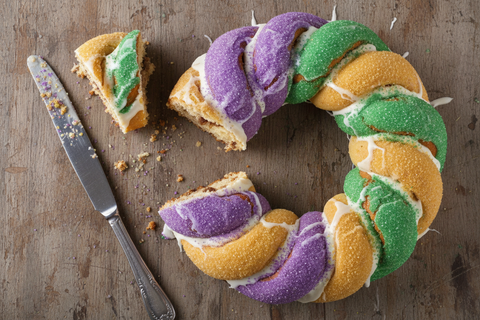
Enter King Cake. To us it’s not just cake, it’s a purple, green, and gold symbol of the most wonderful time of the year, Mardi Gras. A time for celebration and indulgence, for reconnecting with family and friends, and rubbing elbows or trading snacks for beers with a stranger who becomes family by the time the parade is over. And as much as we’d love to take credit for King Cake, people have been celebrating in similar fashion for thousands of years before this brioche-like, sugar laden cake became a part of the city’s tablescapes. What makes our King Cake so different, so revered, are our original revelers and their beliefs.
New Orleans came up at the crossroads of empires, oceans, and survival—and survival makes people spiritual fast.
French Louisiana was deeply Catholic at its roots, and early colonial life was rough, unpredictable, and full of hard luck. Some waves of settlers weren’t exactly arriving as starry-eyed volunteers either—France sent convicts and other “unwanted” populations to help populate the colony in the early 1700s, because building a city in a swamp takes bodies.
Now add the Gulf.
Add the river.
Add sailors, smugglers, privateers, and pirates orbiting the region like sharks around a dock light. And with them comes a whole other belief system: sea-superstition. The ocean doesn’t care if you’re holy—so you learn to respect signs, omens, luck, and little rules that feel ridiculous right up until the moment you don’t follow them.
Then the Spanish arrive.
Spain governed Louisiana for nearly four decades (1763–1803), and Spanish rule meant an even more formal, intensely Catholic framework around daily life. And yes—there were even attempts tied to the Spanish Inquisition era to extend inquisitorial authority into Louisiana, which tells you a lot about the temperature of religion and “correctness” at the time.
And alongside all of that: enslaved Africans—and free people of color—carrying spiritual traditions that emphasized ancestors, protection, charms, blessings, and the unseen forces that move through everyday life. Over time, those traditions merged and mixed with Catholic imagery and practice into what many people recognize today as New Orleans spiritual culture.
So what do you get when you blend:
-
strict Catholic ritual
-
folk belief and fear of “tempting fate”
-
ocean-born luck logic
-
African spiritual traditions built around symbols and protection
You get a city that treats superstition like a sport.
You get New Orleans.
Why King Cake Became the Perfect Superstition Dessert
King cake season begins on January 6th, also known as The Epiphany, the day tied to the arrival of the Three Kings. And in true New Orleans fashion, we didn’t just take that and make it a church thing.
We turned it into:
-
an edible calendar
-
a party schedule
-
an office ritual
-
a bakery economy
-
a dare from the universe
But the biggest reason king cake became superstition gold is simple:
It has something hidden inside.
Historically, king cakes and their French relatives often included a hidden token—what the French call a fève—and that tiny surprise evolved locally into what most people recognize now: the plastic baby.
Which brings us to the rules.
The Unspoken Rules of King Cake in New Orleans
1) You don’t eat king cake before King’s Day
In New Orleans, eating king cake before January 6 isn’t just “early.”
It’s asking for chaos.
This isn’t a light suggestion. It’s the kind of rule people say casually, while also meaning it with their whole heart. Because if king cake is your season-marker, then eating it too soon is like skipping to the last page of the story. It’s like wearing beads in November. Eww.
Sure… you can. But should you tempt the universe like that? (Absolutely not.)
2) The knife stays in the box
This one is so specific it feels like it came from an old spellbook:
Do not remove the knife.
The knife that comes with the king cake is not just a utensil. It’s part of the ritual. People treat it like it’s “assigned” to the cake—like separating the two breaks the protection seal.
Is it logical? No.
Is it New Orleans? Completely.
And if you grew up here, you’ve heard somebody say it exactly like this:
“Don’t take the knife out the box.”*
3) The baby isn’t “cute”, it’s responsibility
The plastic baby might look playful, but in New Orleans it’s basically a contract.
If you get the baby, you’re lucky… and you’re on the hook.
Depending on the crowd, that means:
-
you buy the next king cake
-
you host the next gathering
-
you bring the drinks next time
-
you’re the king/queen for the day
-
you’re officially “it”
This isn’t a myth. It’s an institution. It’s also one of the most New Orleans things imaginable:
luck always comes with a little obligation.
Why We Still Love These Superstitions (Even When We Laugh at Them)
New Orleans doesn’t “do” superstition the way outsiders imagine. It’s not all shadows and seriousness. Here, superstition is often lighthearted, social, and a little theatrical. It’s tradition with personality. It’s community bonding through shared rules that are half joke, half gospel.
And king cake is the perfect example, because it’s a ritual you practice together. Someone brings (another) one to work. Someone is brave enough to take the first slice. Everyone keeps a side-eye lookout to see who got the baby. Everyone secretly hopes it’s not them, and somehow… you get it anyway.
It’s ridiculous. It’s sacred. It’s hilarious. It’s serious.
It’s New Orleans.
The Real Magic: King Cake is How We Keep the Season
King cake superstition isn’t about fear. It’s about marking time. It’s how we tell the universe, “We’ve entered Carnival season.”
It’s how we keep the rhythm of the city.
And whether your people came here through French Catholic tradition, Spanish rule, African spiritual practice, or salty sea-luck logic, one thing is true- New Orleans has always believed that the world holds mysteries.
King cake just happens to be the one we can eat.
*That’s not a typo. If we’re not dirtying a bunch of extra knives, we’re not wasting extra words on it either.
Comments (0)
There are no comments for this article. Be the first one to leave a message!